


How My Experience in Architecture is Helping Me in the Field of UX Design

Transitioning from architecture to UX design might seem like a leap, but both fields share a core principle: they are fundamentally user-centric. As an architecture graduate who has recently entered the field of UX design, I've found that many of the skills and experiences I gained in architecture have been invaluable in my new career. Here’s a look at how my background in architecture is helping me excel in UX design.
Similarities Between UX Design and Architecture
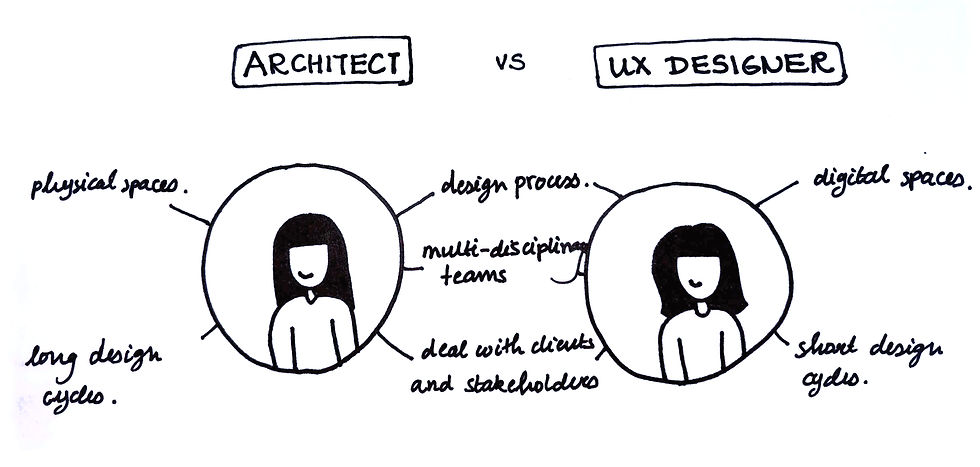
User-Centric Approach:
Architecture: Designing spaces that are functional, safe, and aesthetically pleasing for the people who use them.
UX Design: Creating digital experiences that are intuitive, efficient, and enjoyable for the users.
Problem-Solving Skills:
Architecture: Addressing spatial challenges, environmental factors, and structural limitations.
UX Design: Tackling user pain points, navigation issues, and accessibility concerns.
Iterative Design Process:
Architecture: Developing concepts through sketches, models, and simulations before finalizing the design.
UX Design: Using wireframes, prototypes, and user testing to refine the user interface and experience.
Transferable Skills from Architecture to UX Design
Spatial Awareness and Layout Design:
In architecture, understanding the flow of space is crucial. This skill directly translates to UX design, where the layout of a website or application impacts how users navigate and interact with it. My ability to visualize and organize spaces helps me create intuitive and user-friendly interfaces.
Attention to Detail:
Architecture demands a keen eye for detail, from the placement of windows to the choice of materials. In UX design, this translates to meticulous attention to typography, color schemes, and micro-interactions, ensuring a cohesive and polished user experience.
User Research and Empathy:
Designing buildings requires understanding the needs and behaviors of the inhabitants. Similarly, in UX design, user research and empathy are critical. My experience conducting surveys and interviews as an architect has equipped me with the skills to gather user insights and apply them to design decisions.
Applying Architectural Principles in UX Design
Hierarchy and Structure:
Just as a building has a hierarchy of spaces, a digital interface has a hierarchy of information. Understanding architectural principles of hierarchy helps me prioritize content and create a clear, logical structure in my designs.
Sustainability and Scalability:
In architecture, sustainability involves designing buildings that are efficient and adaptable over time. In UX design, I apply this principle by creating flexible and scalable designs that can evolve with user needs and technological advancements.
Aesthetics and Functionality:
Architecture balances aesthetics with functionality to create spaces that are both beautiful and practical. In UX design, I strive to achieve a similar balance, ensuring that the visual design enhances the usability and overall user experience.
My journey from architecture to UX design has been incredibly rewarding. The skills and experiences I gained in architecture have provided a strong foundation for my work in UX design. Both fields require a deep understanding of user needs, a commitment to problem-solving, and an iterative design process. By leveraging my architectural background, I am able to bring a unique perspective to UX design, creating digital experiences that are not only functional but also engaging and visually appealing.



Comments